
Navigating the 2026 Shift: Q1 Recap & The Case for Continuity
By: Raffaele Mazzone, Lead Portfolio Analyst, April 1, 2026
Part I: Q1 2026 Market Synopsis
The first quarter of 2026 has been a period of recalibration. After a strong 2025, the market met a "triple threat" of headwinds: surging oil prices, escalating Middle East tensions, and sticky inflation.
Performance Recap: The S&P 500 and the Nasdaq 100 closed Q1 down roughly 5 and 6% respectively. This was largely driven by four straight weeks of losses in March amidst valuation, inflation and geopolitical concerns.
The Fed’s Standstill: The Federal Reserve held the benchmark interest rate steady at 3.50%–3.75% in both January and March. While we previously anticipated a faster easing cycle, the Fed has signaled a "higher for longer" stance due to headline inflation hovering near 2.7%–3%.
Geopolitical Friction Points: We cannot ignore the "big news” so far of 2026. Escalating military tensions in the Middle East have introduced fresh risk into energy markets. We are closely monitoring how these tensions impact global trade flows, as any further disruption to key shipping routes and longer duration of these tensions could keep inflation stickier than the Fed would like to see in Q2.
Part II: Q2 Outlook & The Year Ahead
Opportunities in the Market: U.S. stocks currently trade at a 10-15% discount according to Morningstar’s fair value estimates. We believe the current volatility is creating an entry point for undervalued sectors.
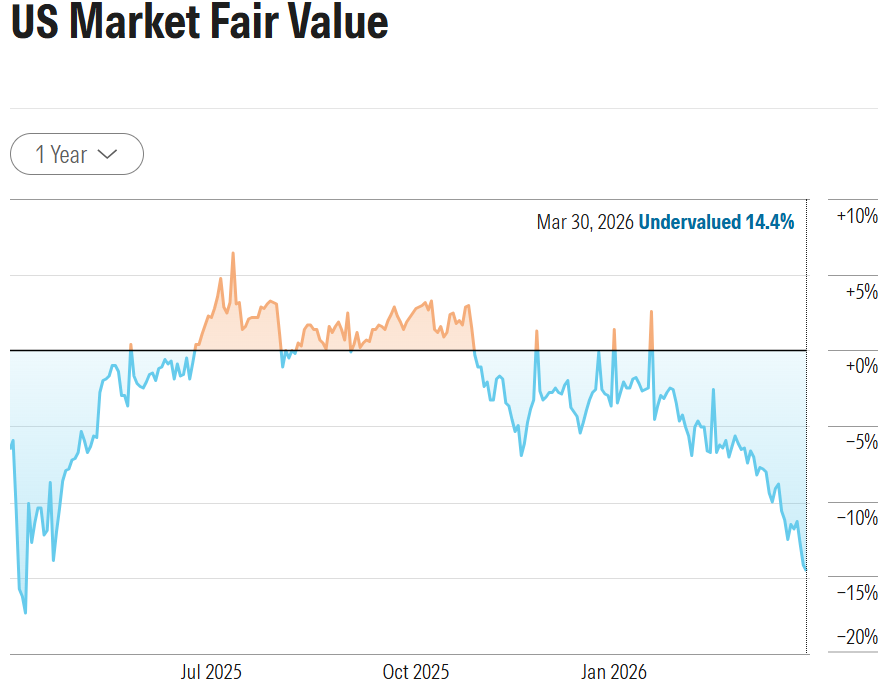
Source: Morningstar Insights https://www.morningstar.com/markets/fair-value
· The International Valuation Gap: While the U.S. has led the way for years, international markets are currently trading at a discount compared to U.S. peers on a price-to-earnings basis. We believe 2026 could be the year these valuations begin to converge. Diversifying geographically isn't just about safety; it’s about capturing significant upside in regions where shareholder value is continuing to be unlocked.
Part III: Why Staying Invested is Your Best Strategy
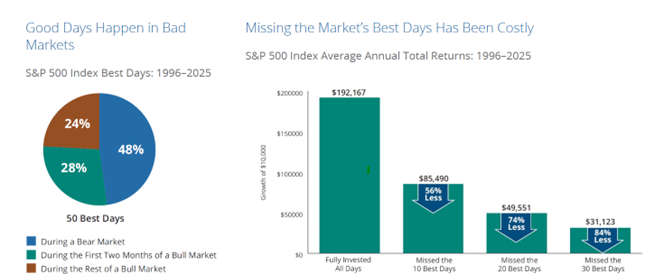
In times like these, the temptation to wait for the dust to settle is high. However, the data reveals that the "cost of waiting" is often the most expensive mistake an investor can make.
1. Missing the "Best Days" is Costly
Market recoveries are rarely gradual. They can happen in sudden, violent bursts. While ideally, an investor could miss all the worst days in the stock market, it is important to recognize that you must be right multiple times. This would involve timing the market perfectly on the downside AND the upside.
2. Longevity is the Ultimate Hedge
Intra Year declines are normal for the markets. Market volatility represents a healthy market. While the stock market can be volatile over the short term, the probability of loss decreases the longer you stay invested. History shows that for a diversified equity portfolio, the range of outcomes narrows significantly over a 10-20-year horizon, eventually trending toward a 100% success rate for positive returns.
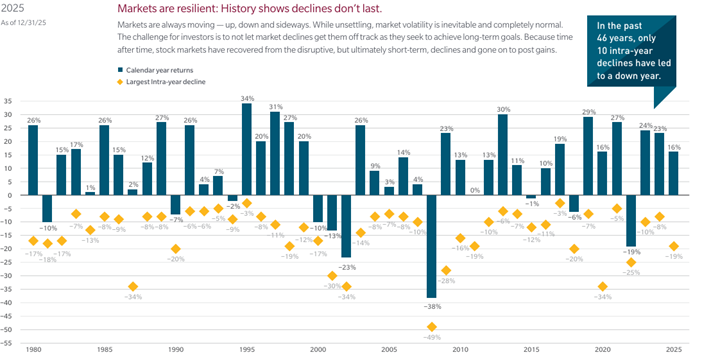
Source: MFS Investment Management https://www.mfs.com/content/dam/mfs-enterprise/mfscom/sales-tools/sales-ideas/mfse_intryr_fly.pdf
The Bottom Line
The goal is not to time the bottom, as nobody does that consistently. Our goal is to maintain a diversified portfolio allocation to recognize the long-term growth of the market. We are keeping your portfolio positioned to participate in the recovery, which, based on every comparable episode in the modern era, comes faster than the fear of the moment suggests.
Disclosure:
Investment advice is offered through Legacy Financial Advisors, a registered investment adviser. The market commentary is for informational purposes only and should not be deemed as a solicitation to invest or increase investments in Legacy Financial Advisors services or affiliated services. The information contained herein is not intended to provide any investment advice or provide the basis for any investment decisions. Additionally, these materials are not intended to provide, and should not be relied on for, any tax or legal advice. Please consult a qualified professional before making decisions about your financial situation. Any reduction in taxes would depend on your specific tax situation. Information and commentary provided by Legacy are opinions and should not be construed as facts. There can be no guarantee that any of the described objectives can be achieved. Past performance is not a guarantee of future results. Information provided herein from third parties is obtained from sources believed to be reliable, but no reservation or warranty is made as to its accuracy or completeness.